
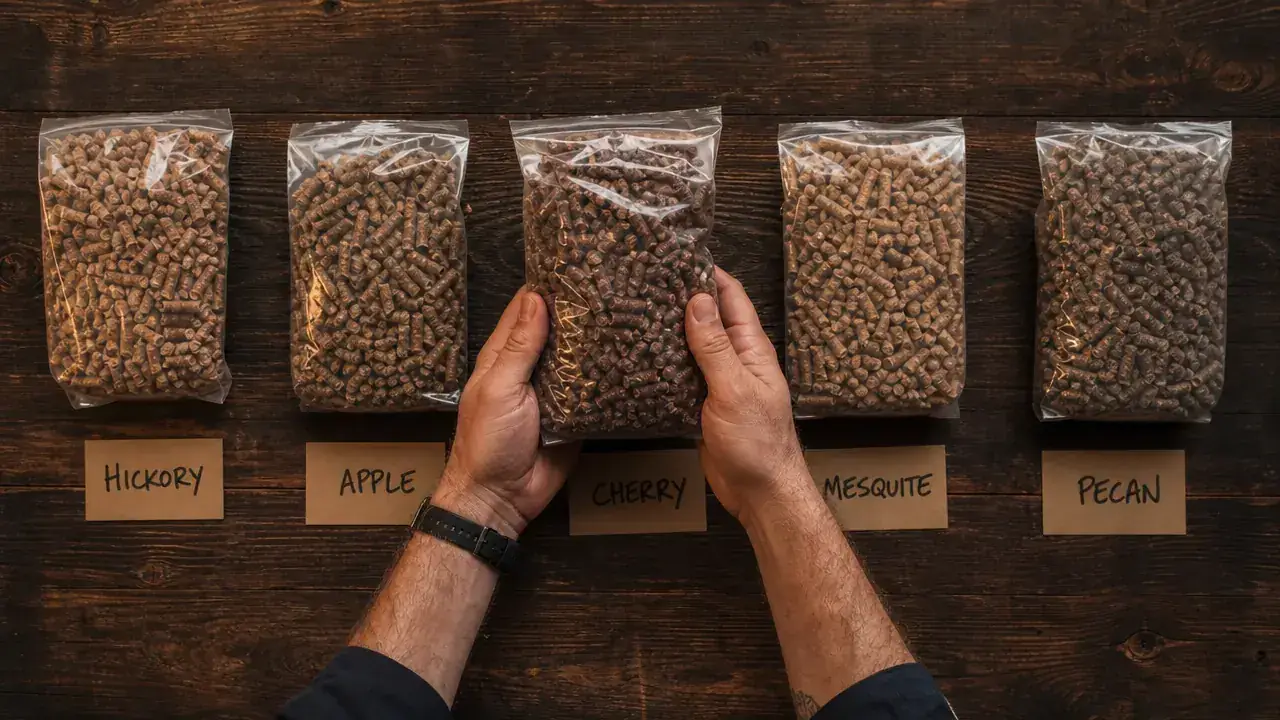
I used the same bag of hickory pellets for everything my first two years of pellet grilling. Brisket, chicken thighs, salmon, pork ribs. All hickory, all the time. My brisket was fine. My chicken tasted like a campfire. My salmon was basically inedible. It took a patient conversation with a guy at a BBQ supply store for me to realize I had been doing the equivalent of seasoning every dish with the same overwhelming spice. The wood matters, and it matters differently depending on what you are cooking.
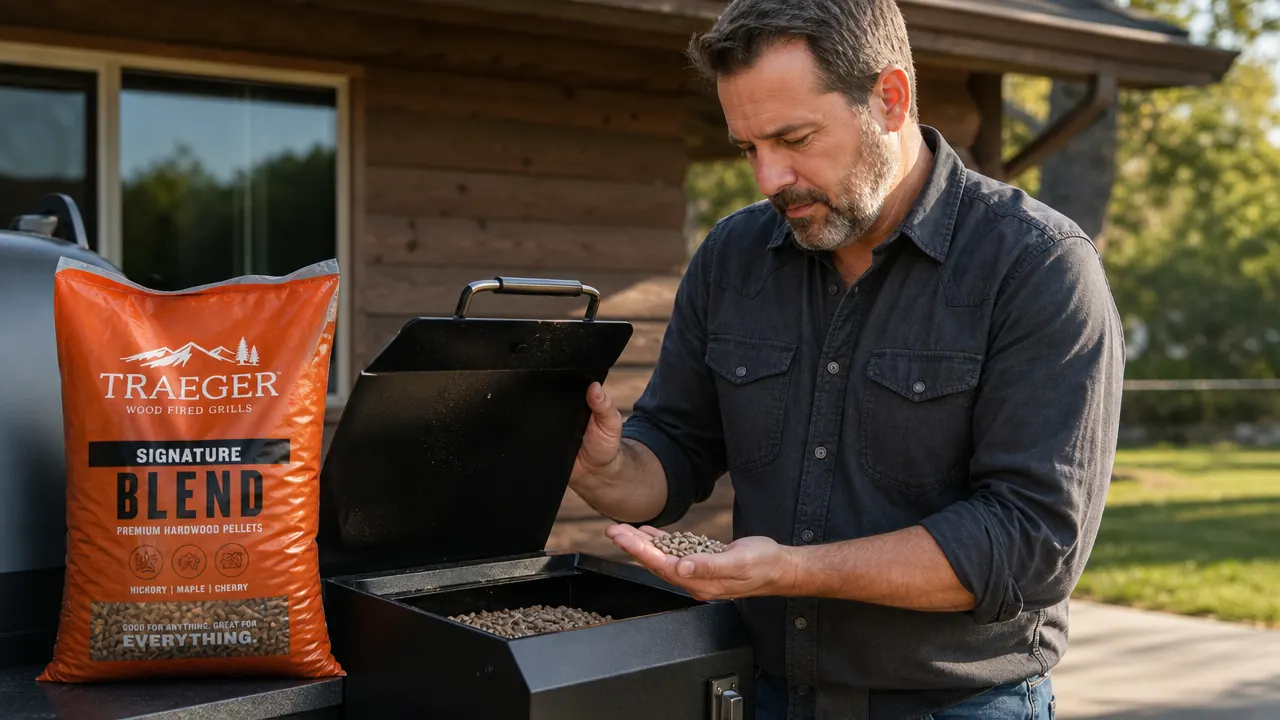
This guide walks through the five most common wood types you will find in pellet form, tells you which proteins they work with, and shows you when a good blend is smarter than any single wood. I will also tell you which bag I keep stocked as a universal fallback when I am not sure what I am making yet. Spoiler: it is Traeger Signature Blend, and after running through dozens of cooks with it I understand exactly why it has more than 50,000 reviews on Amazon.
Want one bag that handles any protein you put on the grill?
Traeger Signature Blend combines hickory, maple, and cherry into a balanced smoke profile that works on beef, pork, poultry, and everything in between. 4.8 stars from 50,956 reviews. Check today's price before your next cook.
Amazon Check Today's Price on Amazon →Why Wood Type Matters More Than You Think
Different woods produce different combustion byproducts, and those compounds stick to the surface of your meat differently depending on the protein's fat content and cook temperature. Delicate proteins like fish have very little surface fat to buffer intense smoke compounds. Dense proteins like brisket have hours to absorb smoke gradually, and a bold wood like hickory has time to round out and integrate. Matching the wood to the meat is not pretentiousness. It is just physics and chemistry working in your favor.
There is also a practical dimension. Strong woods used on a long cook can tip from smoky to bitter, especially if your fire pot runs too cool and produces dirty white smoke instead of clean blue smoke. Milder woods give you more margin for error. That matters on a 14-hour overnight brisket where you are not babysitting every temperature fluctuation.
Step 1: Understand the Smoke Intensity Spectrum
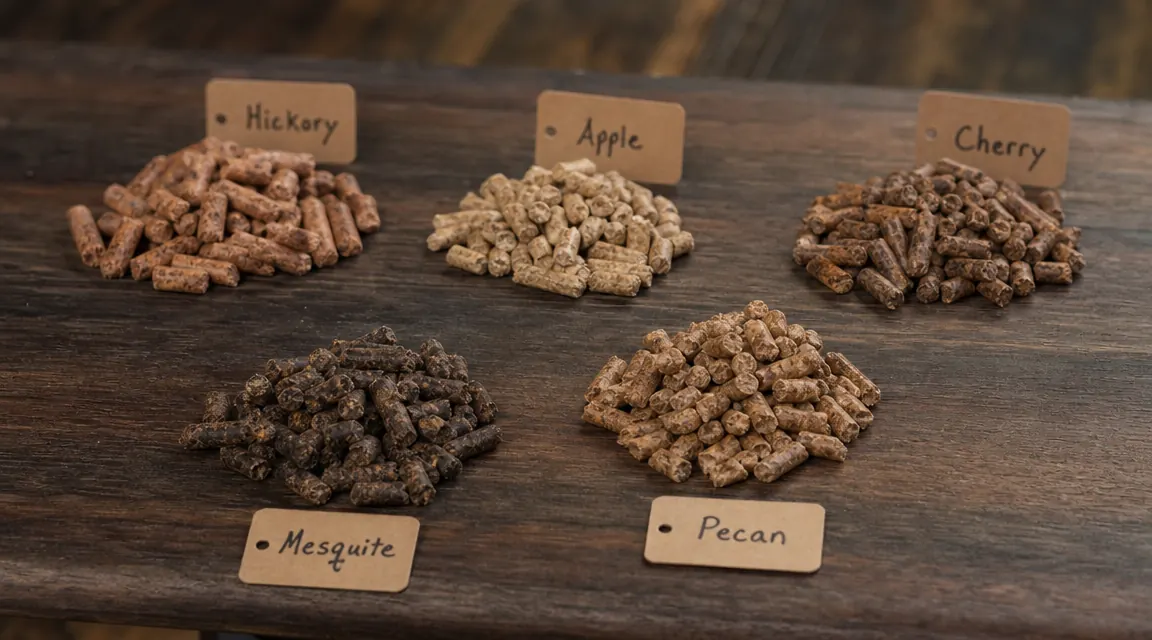
Before you match any wood to any meat, you need a mental model for where each wood falls on the intensity spectrum. Think of it as a dial from 1 to 10. Alder and apple sit at the mild end, around 2 to 3. They produce light, sweet, faintly fruity smoke that stays in the background. Pecan and cherry sit in the middle, around 4 to 6. Cherry in particular adds a subtle sweetness and a deep reddish color to the bark. Hickory is a 7 to 8. It is the most commonly used strong wood in American BBQ because it has a familiar, bacony depth without the aggression of mesquite. Mesquite is a 9 to 10 and is easily overdone, especially on anything that cooks longer than two hours.
Most quality blends land in the 5 to 7 range because they are formulated to be broadly compatible. Traeger Signature Blend uses hickory, maple, and cherry in a ratio that puts it right around a 6 to 7. Enough smoke character to matter on a brisket, gentle enough that chicken does not come out tasting like a bonfire.
Keep this spectrum in your head. Every pairing decision in this guide flows from it.
Step 2: Match Beef to Bold Woods
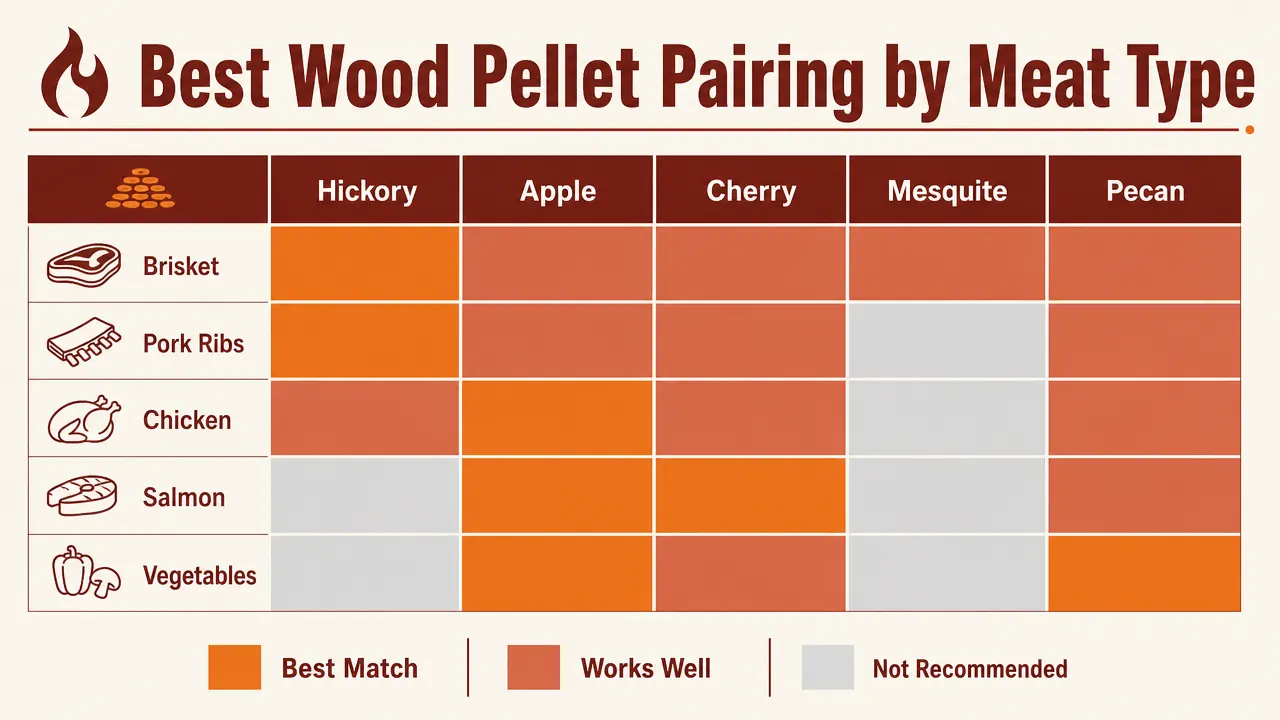
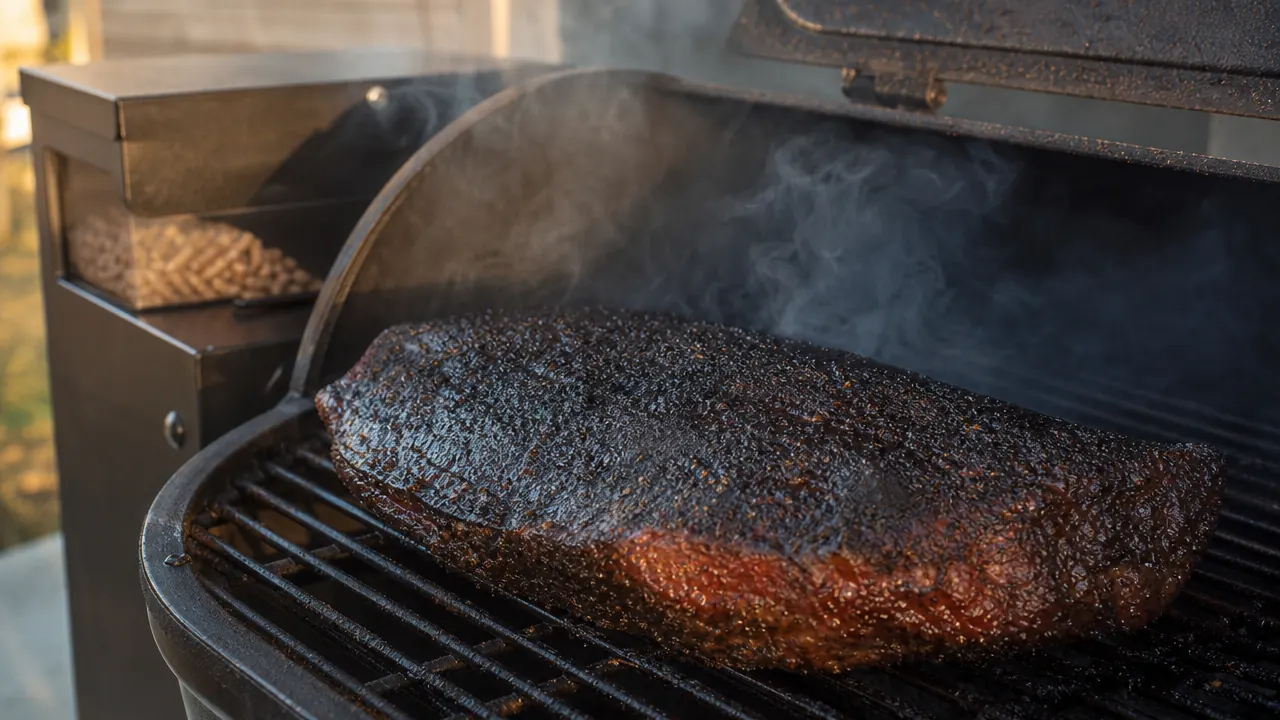
Beef is the one protein that can take serious smoke without losing its identity. A brisket flat has enough intramuscular fat and enough surface area to absorb a bold wood and still taste like beef first, smoke second. My go-to for brisket, beef short ribs, and chuck roasts is hickory. It gives you that classic Texas-style bark and the deep smoke ring that makes people lean in for a closer look when you slice it.
Oak is also excellent for beef and is arguably more forgiving than hickory on very long cooks. If you are doing a 16-hour brisket and you are worried about smoke creeping into bitter territory overnight, oak gives you similar depth with a slightly softer edge. Post oak is the wood of choice at the most respected Central Texas BBQ spots for a reason.
For burgers and steaks that only spend 20 to 45 minutes on the grill, hickory or a hickory-forward blend is perfect. The short cook time means you get a nice smoke kiss without accumulating too much. Avoid mesquite on steaks unless you are cooking at very high heat for fewer than 15 minutes, because the aggressive compounds need high heat to burn clean.
Step 3: Match Pork to Sweet and Medium Woods
Pork is where fruit woods really shine. Apple and cherry both complement the natural sweetness of pork without competing with it. Apple smoke is lighter and produces a clean, mild sweetness. Cherry goes slightly deeper and adds visible color to the bark and ring. When I am doing a pork shoulder for pulled pork, I often mix apple and cherry if I have both bags open, or I reach for a blend that includes cherry. You get a beautiful reddish bark and a smoke flavor that reads as sweet and balanced, not harsh.
Ribs are a bit more forgiving than shoulder because the cook is shorter, usually five to six hours on a 3-2-1 method. That means you can use hickory on ribs and it works great. But if you want competition-style color and a slightly sweeter profile, cherry or a cherry-hickory blend is the smarter call. Traeger Signature Blend has cherry in the mix, which is part of why it performs so well on ribs.
Ham is a special case. If you are doing a fresh uncured ham, treat it like pork shoulder and use apple or cherry. If you are smoking a pre-cured ham to finish it, it already has strong flavor, so go light and use apple or a mild blend. You are just adding a layer, not building from scratch.
Step 4: Match Poultry to Mild Woods
Chicken and turkey have thin skin, lean white meat, and not much fat buffer. They pick up smoke fast, especially the skin. A bold wood like hickory applied to a spatchcocked chicken at 275 degrees for two hours will give you a smoke flavor that overwhelms the bird. The meat underneath does not have enough richness to absorb it gracefully.
The best woods for poultry are apple, cherry, and maple. Apple produces the most delicate smoke, which lets the natural flavor of the chicken or turkey stay up front. Cherry adds a little color and a slight sweetness that works particularly well on whole birds where you want good visual color on the finished skin. Maple is often underrated for poultry. It has a subtle caramel sweetness that pairs well with a simple salt and pepper rub.
If you only have hickory in the hopper and need to cook chicken, you can still do it. Just cook at a higher temperature, around 325 to 350 degrees, so the cook time is shorter and the smoke absorption is reduced. But if you have the option to swap bags, use something milder.
Chicken picks up smoke fast and does not have the fat to buffer a bold wood. If your bird tastes like an ashtray, the pellets are probably the problem, not your cook time.
Step 5: Match Fish and Seafood to the Gentlest Options
Fish is the most smoke-sensitive protein you will cook. A salmon fillet at 225 degrees for 90 minutes will pick up smoke aggressively because the flesh is soft and open. Use alder if you can find it in pellet form. It is the traditional wood for smoked salmon in the Pacific Northwest for a reason. The smoke is so light it almost disappears, leaving just a hint of wood character behind the fish flavor.
Apple works almost as well as alder and is far easier to find. If you only have a blend in the hopper, do a short cook at a higher temperature to limit smoke exposure. Avoid hickory and mesquite on fish entirely unless you want the wood to be the dominant flavor.
Shrimp and lobster tails follow the same logic. Light fruit wood, short cook, high heat. You are adding a smoke accent, not a smoke blanket.
What Else Helps
Wood choice is the biggest variable, but a few other things affect how the smoke lands on your food. Pellet quality matters more than most people realize. Cheap pellets often use filler woods with flavor oil sprayed on, so the smoke character is inconsistent and sometimes chemically off. Traeger Signature Blend is made from 100 percent all-natural hardwood with no fillers and no binding agents, which means the burn is consistent across the whole bag. When I run a temperature test between a quality pellet and a dollar-store brand, the quality pellet holds temperature tighter and produces cleaner smoke.
Cook temperature also shapes how smoke behaves. Below 200 degrees, pellet grills can produce thick, white smoke that is not clean-burning. That smoke is more acrid and can make food taste bitter regardless of the wood type. The sweet spot for clean, blue smoke on most pellet grills is 225 to 275 degrees. If you are seeing heavy white smoke pouring out at the start of a cook, let the grill come up to temperature and stabilize before you put the meat on.
Finally, how you store your pellets matters. Wood pellets absorb moisture from the air and break down when they do. Degraded pellets burn inconsistently, clog the auger, and produce weak smoke. Store them in a sealed container in a dry place. A five-gallon bucket with a gamma-seal lid works well. Do not leave the bag folded over in the grill's hopper between cooks if you live somewhere humid.
If you want one bag that handles the full range of what most backyard pitmasters cook, Traeger Signature Blend is the right answer. Hickory for depth on beef, maple for a neutral midrange, and cherry for sweetness and color on pork and poultry. All three in a single bag, pre-balanced, and available for today's price below. Check the full long-term review if you want more detail on how it performs across a full season, or see how it fits into a complete pellet grill setup in the Z Grills 450A2 review.
The one bag that covers beef, pork, poultry, and more.
Traeger Signature Blend is hickory, maple, and cherry in a single bag. No fillers, no binders, just all-natural hardwood that burns clean and tastes like it should. Over 50,000 five-star reviews and counting.
Amazon Check Today's Price on Amazon →