
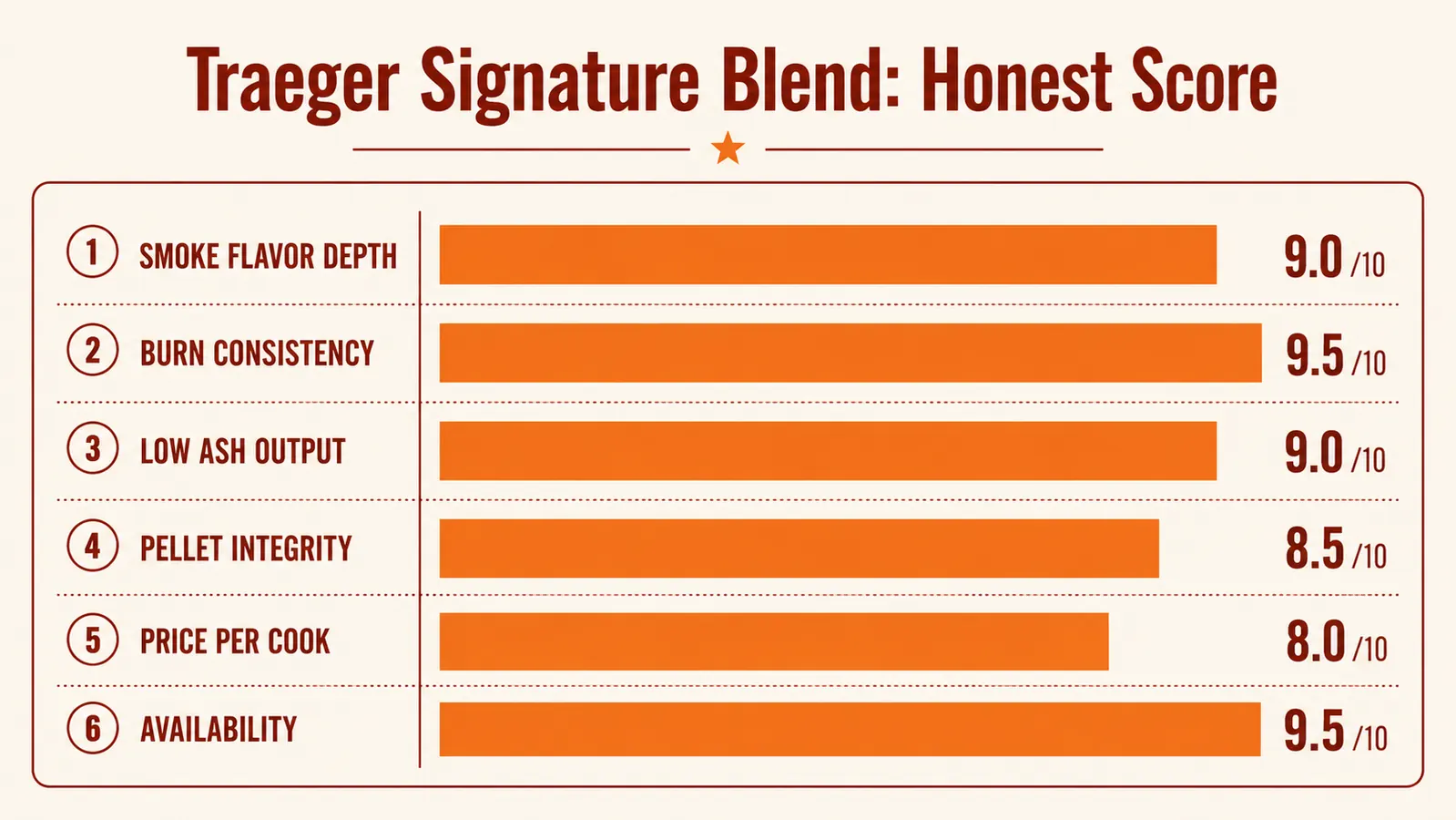
There is a version of this review where we just nod along with 50,000 Amazon buyers and call it a day. Traeger Signature Blend has a 4.8 out of 5 rating on over fifty thousand reviews. Statistically, that is an almost impossible score for a consumable product in a category where most buyers are opinionated. But we have been at this long enough to know that review counts can flatten out the real story. So we ran four bags side by side over six cooks to find out what all those stars are glossing over.
The short answer is that Traeger Signature Blend is genuinely good. The longer answer is that the reasons it is good are not necessarily the reasons the marketing says it is good, and there are a few situations where you would be better served by a different bag. We cover all of that below, including what we noticed about ash output, smoke intensity, hopper behavior, and cost-per-cook compared to the three brands we tested against it.
The Quick Verdict
A reliable, consistent all-rounder that earns its rating, but it is not the strongest smoke producer on the market and the price premium over Bear Mountain is hard to justify unless you are already in the Traeger ecosystem.
Amazon Check Today's Price →Want consistent smoke without spending a Saturday troubleshooting pellet problems?
Traeger Signature Blend delivers steady burn temps and predictable smoke flavor. It is one of the safest all-around choices for brisket, ribs, and chicken without chasing a specific wood type.
Amazon Check Today's Price on Amazon →What Nobody Mentions in the Five-Star Reviews
Most positive reviews say some version of: great smoke flavor, burns clean, works great. That is all true. What those reviews typically skip is the context around each of those claims. Burns clean compared to what? Great smoke flavor relative to which wood? Works great on which grill brand? We dug into each of these.
Signature Blend is a hardwood mix of hickory, cherry, and maple. The ratios are not publicly disclosed. What that blend profile produces in practice is a medium-bodied smoke that sits comfortably between the sharpness of straight hickory and the sweetness of straight cherry. For cooks where you want smoke that complements rather than dominates, it earns the rating. But if you are cooking a full packer brisket and you want a deep mahogany bark with serious smoke punch, this blend will leave you wanting more.
We cooked two pork shoulders back to back on the same grill at the same temperature, one run with Traeger Signature Blend and one with CookinPellets 100% hickory. The difference in smoke ring depth was noticeable. The CookinPellets cook had a thicker ring and a more assertive smoke flavor on the outer inch of meat. Traeger Signature Blend was more approachable, especially for guests who are not hardcore smoke fans, but it is not what you reach for when you want to announce that something spent fourteen hours in the smoker.
Ash Output: Better Than We Expected, Not Perfect
Ash production matters more on a pellet grill than most buyers realize until they have cooked on one for a season. Excessive ash in the firepot causes temperature spikes, irregular burns, and in the worst case, a flameout mid-cook. We measured ash output on a per-cook basis for all four pellets we tested.
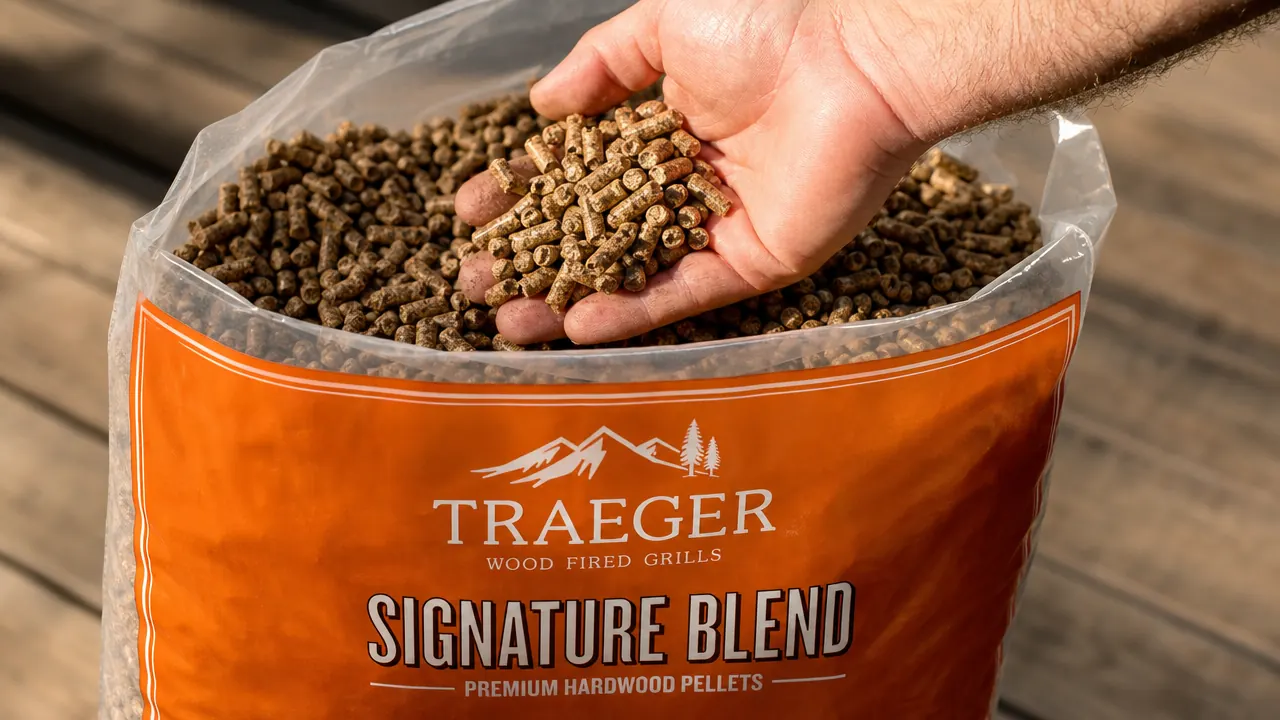
Traeger Signature Blend produced less ash than CookinPellets and roughly the same amount as Camp Chef Competition Blend. Bear Mountain BBQ Pellets produced measurably less ash than all three, which surprised us. Traeger's ash was also finer in texture, which meant it settled into the firepot more densely rather than puffing out when the auger fed new pellets. That is actually a minor advantage because denser ash is easier to vacuum out in a single cleanout session.
We did see one issue that shows up when you push pellet grills hard for long cooks: at a sustained 275 degrees over twelve hours, the Traeger pellets produced a small clinker in our firepot by hour ten. A clinker is a compressed ash disk that can partially block the igniter on the next startup. It happened once out of six cooks, and it cleared without issue on startup, but it is worth knowing. CookinPellets and Bear Mountain did not produce clinkers in any of our test runs.
Moisture Content and Hopper Behavior in Humidity
We are in central Texas. If you grill outdoors regularly, you know that summer humidity is not a theory. Pellet moisture content is one of the factors that separates a premium bag from a budget bag, and it is also one of the things Traeger handles better than most of the competition.
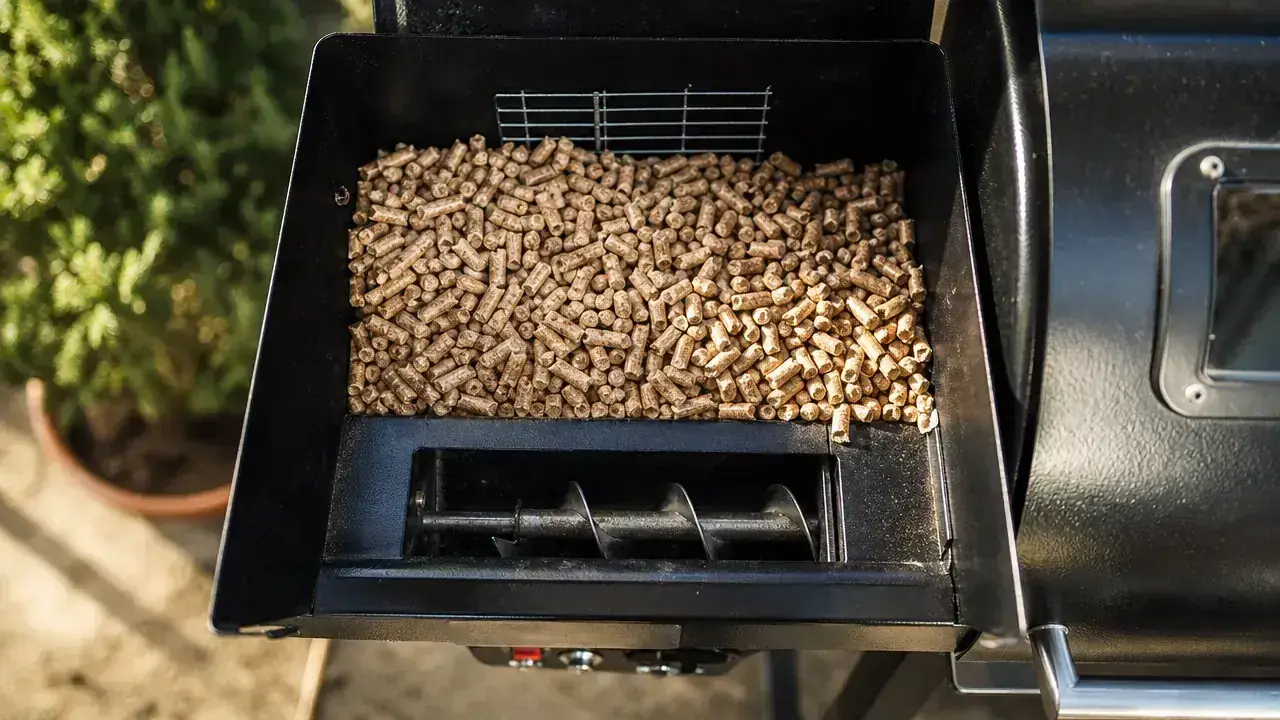
Traeger Signature Blend bags are sealed tightly and the pellets themselves maintained low moisture content even after we left an open bag outside under a covered porch for two weeks during a stretch of humid weather. Low-quality pellets will swell and start to crumble when they absorb humidity, which jams augers and causes inconsistent burns. Traeger pellets stayed intact and fed through the auger without issue throughout that period.
That said, no wood pellet is immune to moisture over time. If you leave a partial bag open and unsealed in a humid garage through a full summer, you will see degradation. Traeger is more forgiving than budget pellets in this regard, but the actual answer to hopper headaches is to seal your bag between cooks. We use a chip bag clip on every bag regardless of brand. The pellets hold up fine when you treat them right.
One thing worth calling out: we noticed that the Traeger bag's resealable design is better than most competitors. The thick polyethylene bag with a fold-top seal stays closed reliably and does not split at the seam the way some thinner-wall pellet bags do when you grab them roughly by the top. That is a small quality-of-life detail, but after enough bags of pellets torn open and left half-sealed on a shelf, it stops feeling small.
Traeger Signature Blend is the pellet we hand to a first-timer who asks what to buy. It is forgiving, consistent, and it has not let us down on a single family cook. But it is not the pellet we reach for when we are trying to impress someone who knows smoke.
Price Per Cook: The Number That Changes the Math
Traeger Signature Blend runs around twenty dollars for a twenty-pound bag. That is a standard price for a branded pellet from a major grill manufacturer. If you are cooking a six-hour pork butt at 225 degrees, a mid-size pellet grill will typically burn through three to four pounds of pellets. At the current price, that is roughly four dollars worth of fuel per long cook, which is not painful.
Bear Mountain BBQ Pellets on a per-pound basis typically run slightly cheaper, and in our side-by-side test they performed comparably for everyday cooks. If you are cooking every weekend through a full grilling season, May through October, that difference adds up to real money. For a casual three-cooks-a-month griller, the price gap between Traeger and Bear Mountain is not going to move the needle. For someone cooking two or three times a week during summer, it is worth doing the math.
We also want to be direct about one Traeger-specific pattern we have noticed: when you buy a Traeger grill, the company makes it easy to default to Traeger pellets at checkout and in their app. That is a smart business move on their part, but it does not mean the pellets are uniquely superior. They work well on any pellet grill, not just Traeger hardware. If you own a Z Grills, a Camp Chef, or a Pit Boss, you can run Signature Blend without any issue. The pellets do not care what brand of grill they are burning in.
Smoke Flavor: Genuinely Versatile, Genuinely Mild
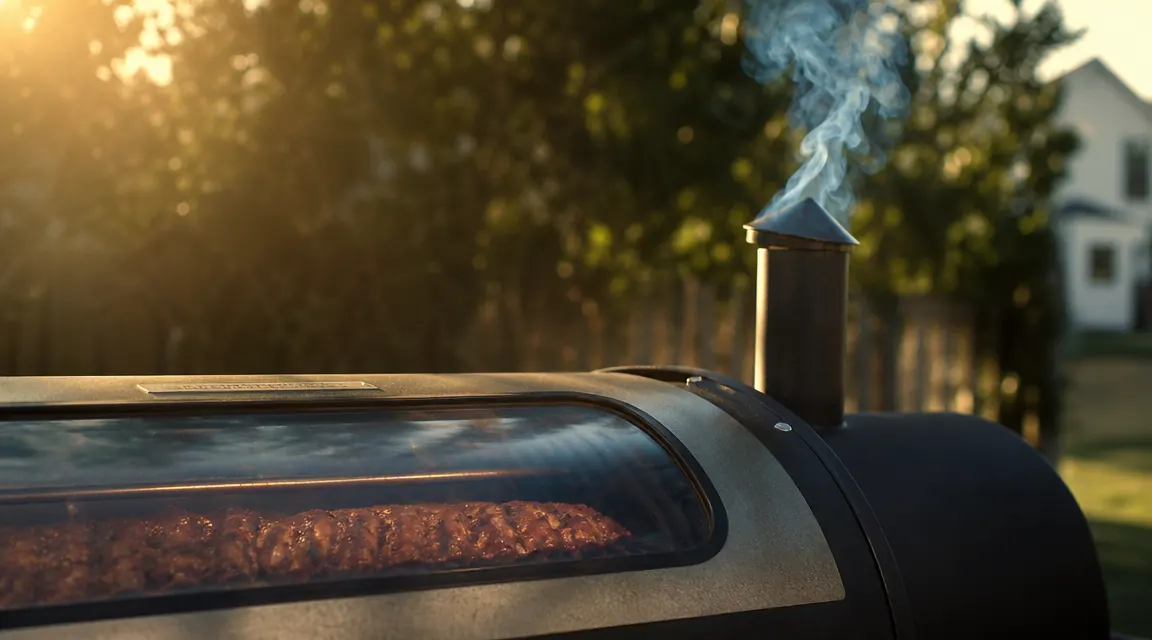
The hickory-cherry-maple blend was clearly designed to work on everything. Chicken, pork, beef, vegetables. It threads the needle between sweet and savory, which is why it works well as a general-purpose pellet. The tradeoff is that it does not excel at any one thing. If you are cooking brisket and you want a deep, assertive smoke crust, you will find Signature Blend too polite. The smoke flavor is present but restrained.
For chicken thighs at 325 degrees, the cherry component in the blend comes forward and produces a nice caramelized skin with a gentle smoke note. That is a genuinely excellent result, and it is where we think Signature Blend is at its best. For baby back ribs at 225 over five hours, the hickory is more present and the results are solid without being spectacular. For a beef brisket at 250 degrees over twelve hours, we preferred the CookinPellets hickory and the Bear Mountain Bold BBQ blend over Signature Blend. Both pushed more smoke into the flat and produced a darker bark.
What We Tested Against and What Surprised Us
We ran the same six cooks across four pellet types: Traeger Signature Blend, Bear Mountain BBQ Pellets (their Competition Blend), CookinPellets 100% hickory, and Camp Chef Competition Blend. Same Z Grills grill, same meat weights, same cook temperatures, same probe placement. Not a lab test, but controlled enough to see real differences.
Bear Mountain surprised us most. It produces a slightly stronger smoke flavor than Traeger Signature Blend on beef, cleaner ash output, and costs less per pound. On chicken and pork, Traeger Signature Blend and Bear Mountain were functionally identical. If we had to choose just one of the two to run through a full season, we would probably land on Bear Mountain for long beef cooks and Traeger Signature Blend for variety packs of chicken and ribs where you want smoke that does not overpower a crowd-pleasing rub.
CookinPellets came in third overall because the ash output was the highest of the four and the bags are marketed specifically for smokers who want heavy smoke, not everyday grilling. They are not a general-purpose pellet. Camp Chef Competition Blend performed similarly to Traeger Signature Blend in most categories but had slightly less consistent pellet sizing, which caused one minor auger hesitation during a cold morning startup.
If you want a deeper comparison of how Signature Blend stacks up against Bear Mountain on price, smoke flavor, and burn consistency, we have a full head-to-head in our Traeger Signature Blend vs Bear Mountain writeup. And if you are trying to figure out which wood type is actually right for what you are cooking, the guide on how to choose wood pellets for different meats walks through every major protein and the wood that pairs best with it.
What I Liked
- Consistent pellet sizing with very few fines in the bag
- Durable moisture resistance compared to budget pellets
- Versatile hickory-cherry-maple blend works acceptably on all protein types
- Widely available on Amazon with reliable stock and fast shipping
- Fine-grain ash that is easier to vacuum out than coarser pellet ash
Where It Falls Short
- Smoke flavor is noticeably milder than single-wood or bolder blend competitors
- Higher price per pound than Bear Mountain with comparable everyday performance
- Produced one clinker during a twelve-hour high-heat cook in our testing
- Blend ratios are not disclosed, so you cannot tune it by wood type for a specific cook
- Premium branding adds to the price without adding proportional smoke performance
Who This Is For
Traeger Signature Blend is the right pellet if you grill for mixed crowds who are not all smoke-forward flavor fans, if you mostly cook chicken and pork, or if you are new to pellet grilling and want a reliable bag that will not cause firepot problems or smoke off-flavors while you are still learning the grill. It is also a solid pick if you travel and compete at BBQ events where you want a crowd-pleasing middle ground rather than a polarizing heavy-smoke profile.
It is also a good choice if you host large cookouts where the food needs to land well for a wide range of palates. When you are feeding thirty people, a subtle smoke profile is easier to play to than an aggressive one. Guests who have never had wood-smoked food will notice the smoke pleasantly without feeling overwhelmed. For that hosting scenario, Signature Blend is very hard to beat at its price point.
It is also worth noting that if you own a Traeger grill and you want to keep your warranty claims smooth, running Traeger brand pellets is a low-friction choice. Traeger does not officially void warranties for running competitor pellets, but their customer support is easier to navigate when you are in their ecosystem. That is a real-world consideration even if it should not technically matter.
Who Should Skip It
If you are cooking primarily beef brisket or beef ribs and you want maximum smoke penetration and bark development, skip Signature Blend and go straight to Bear Mountain Bold BBQ or CookinPellets 100% hickory. You will get a more assertive result. If cost per cook matters to you over a full season of frequent grilling, Bear Mountain gives you comparable or better performance at a lower per-pound price. And if you already have a specific wood affinity because you used to cook on a stick burner, a blend pellet will always feel like a compromise compared to running a single-wood pellet that matches your preferred flavor profile.
We also would not recommend Signature Blend as a primary fuel for fish or game. The cherry component in the blend can introduce a sweetness that fights with lean, delicate proteins. For trout, salmon, or venison, we prefer apple-only or alder pellets. Signature Blend is built for the most common backyard proteins, and it stays in that lane.
Ready for a pellet that works out of the bag without surprises?
Traeger Signature Blend is one of the most consistent all-purpose pellets we have tested. If you want a bag that performs reliably on chicken, ribs, and pork without chasing a specific wood type, this one delivers. Check the current price and stock on Amazon before your next cook.
Amazon Check Today's Price on Amazon →